
Killing Giants
Abhayabhumi forgotten

Opinions expressed within the content are solely the author’s and do not reflect the opinions and beliefs of any listed websites, their affiliates, any entity—physical or otherwise—anything, anyone, or any other form of matter that isn’t completely and uniquely me.
9 March 2026
Abhayabhumi
Abhaya / अभय in Sanskrit means “fearless,” “without fear,” “safety,” or “protection.” It’s often used in religious and philosophical contexts to mean freedom from fear or being safe and secure.
Bhūmi / भूमि means “land,” “ground,” or “territory.”
An ancient doctrine that distributed a message of responsibility toward the protection of all living beings and Sri Lanka’s natural heritage, offering a living legacy in global environmental conservation. A motivating force of compassion. The first word for Sanctuary in any language, and still today the Sinhala word for the same.
In the ancient texts, the concept of Abhayabumi stated that the King’s duty was to provide sanctuary to all sentient beings.
However, Sri Lanka (like many other countries) has forgotten their old teachings due to colonialism and capitalism.
Sri Lanka is a biodiversity hotspot. Along with its endemic species and plethora of medical plants, it has been hailed as a paradise of natural diversity.
Sadly, their peaceful indigenous ideals of democracy have been undermined, and today, Sri Lanka risks the collapse of its immensely biodiverse heritage.
This isle of giants is slowly losing its namesakes.
Elephants
Sri Lanka is renowned for their elephants. The Sri Lankan elephant (Elephas maximus maximus) is the largest subspecies of the Asian Elephant, and Sri Lanka, as an island, holds the most number of Asian elephants.
Elephants are lauded as lords in local folklore, yet are broken through beatings with metal hooks, chained to floors in temples, and are subject to becoming road kill - mowed over by speeding vehicles - left to die worthless and bleeding.
It’s barely March, and already 44 elephants have been killed in 2026 (at the time of writing). Unfortunately, statistics like these are not new. There has been a long-standing issue on ‘elephant-human conflict’ here.
However, if one were to follow the ideals of Abhayabumi, first we much change our language use. Conflict implies a negative relationship, and suggests that no solution will be found - that this conflict is how things are. However, simply exchanging that confrontational word of ‘conflict’ to ‘co-existence’ we start to believe there could be a better path forward.
Elasmobranchs (Sharks and Rays)
Sri Lanka holds the dubious record of killing the most mantas and devil rays compared with all global and large industrial purse seine fisheries combined.
As per a report on the Global Threat to Manta and Mubula rays, out of the 3,409 manta rays captured by 13 countries a year during the study, Sri Lanka’s fishing fleet caught 1,055; or one-third. But, when considering all the mobula rays, the total global catch recorded a year was 100,053; while the Sri Lankan fishing fleet was responsible for 56,552; accounting for nearly 60% of the global catch. - Earth Journalism
I had the great horror of recording this video.
We were driving in the car and I spotted this manta being dragged out of the water, and so we drove closer to have a look.
While mantas and the rest of the mobulids remain unprotected locally in Sri Lanka, they are classified as endangered under international conventions like CITES.
No person engaged in fishing operations in Sri Lanka Waters shall catch any shark of the species specified in the Schedule hereto except for the collection of museum, biological sampling for taxonomic study and research purposes.
- Sri Lanka Fisheries & Aquatic resources Act, No. 2 of 1996
Rays are not the only elasmobranchs that end up dying for humans’ sake.
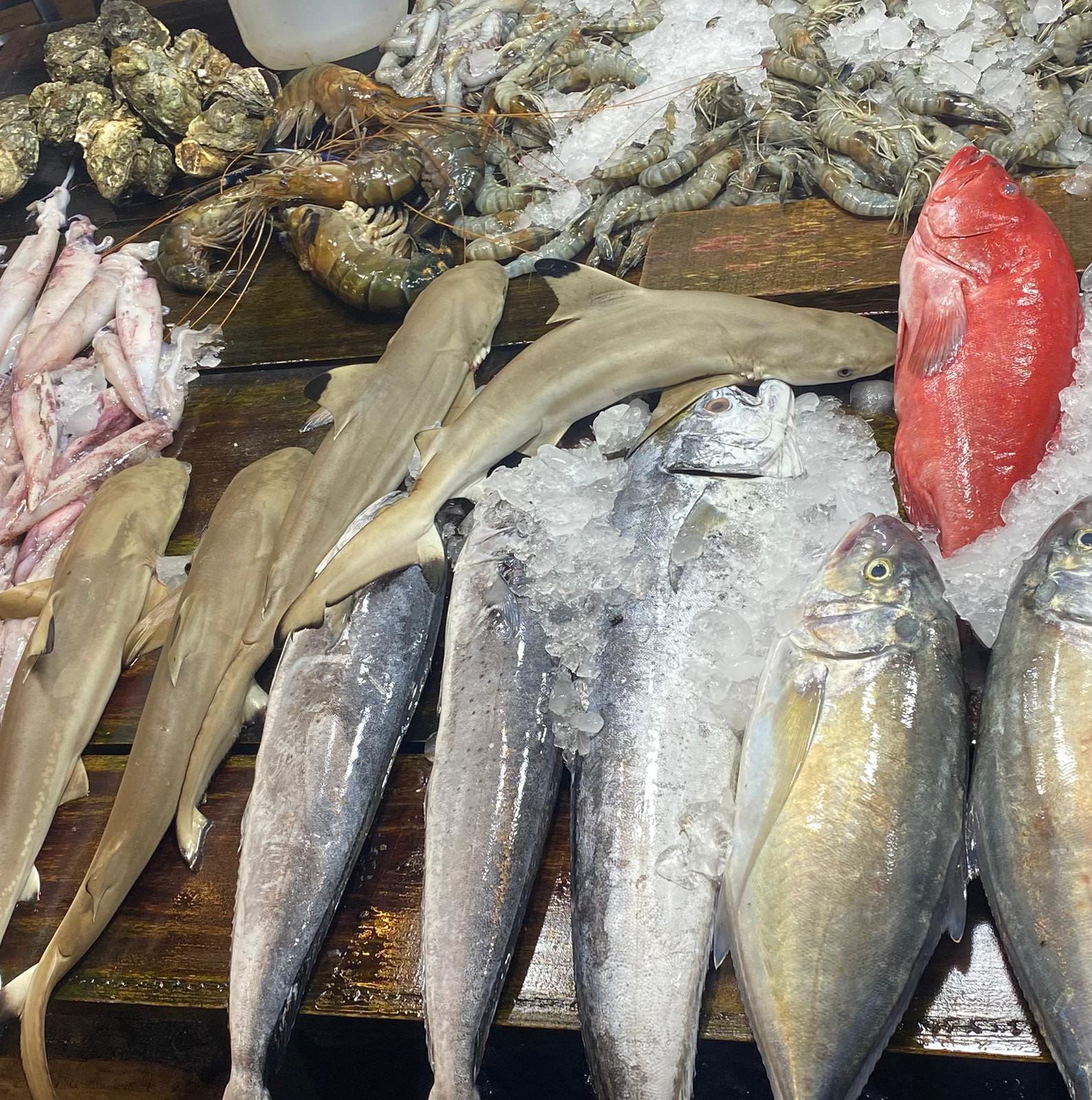
I captured this photo in plain sight on a roadside cart of a fisher - baby black tipped reef sharks, sold to be eaten at a popular tourist spot down south.
Apart from being actively hunted, these giant flying carpets and apex predators both die as bycatch and getting tangled in fishing nets contributing to their fast declining numbers.
These sharks are also considered a vulnerable species under IUCN’s categorisation.
Whales
Sri Lanka is blessed to have nutrient-rich waters all around its coast. Depending on the time of the year, you can find whales migrating past this tear-shaped playground.
All year round however, you can also find big ships navigating the same deep waters. And they ain’t gonna slow down for no one - not even the biggest animal on the planet - the blue whale, another endangered giant found here.
Tourist whale watching boats culprits too. With fat prices being paid to see whales, eager boat captains speed off to get their cut, and make sure that they go home with bulging pockets. This of course adds to already growing fatal ship strike statistics, and pushes the whales away from their usual hangouts.
A recent global study published in 2024 estimated that thousands of whales are injured and killed each year after being struck by ships.
Numbers of Blue Whale deaths from these collisions are estimated due to whale carcasses sinking to the ocean bottom before being noticed, however with an already declining population, we can’t afford to lose anymore of our planet’s largest giants.
While most of Sri Lanka is Buddhist, principles of ahimsa or nonviolence don’t seem to apply when manta gill plates, shark fins, and exotic meals sell for a lot of money in the Chinese medicine and burgeoning tourist markets.
And who are we to blame them, really?
As much as it would be easy for me to point fingers and say this is wrong. I have no right. The blood of all those dead animals, and the thousands of others that are slaughtered every day are also on my hands.
Our silence is complicit in their deaths.
The concepts of Abhayabumi started in Sri Lanka as early as the 3rd Century.
Poson Poya is the annual festival of the celebration of the arrival of Buddhism here. Millions of people congregate at the Mihintale Temple to honour the traditions that were started at this sacred space - where it was first said that “all sentient beings have the right to life and liberty, without interference or fear. That all have the right to peace and prosperity, and it was the duty of the King to ensure those rights were protected.”
But this decree should resound in the hearts and actions of all - people in authority, people who rule, and people who breathe.
It is not just Sri Lanka that needs to remember.
These atrocities to the natural world are happening everywhere. We are killing for money, territory, fame, fortune, and status. We have become so disconnected and disenfranchised that nothing seems to faze us anymore.
Hypernormalism in a hyper-insane world.
Colonialism, Capitalism and Neo-liberalism are the antithesis of indigenous concepts like Abhayabumi. They are also new in comparison, and have been constructed to serve an imaginary economy, while they raze the very much tangible world that we live in. A world much, much older and wiser than we seem to think we are.
We all come from non-anthropocentric roots.
There was a time where we lived in harmony with the other than human and the more than human - and that was a time of flourishing.
We are watching that world unravel.
We can barely live in harmony with our own species.
But what has been forgotten can be remembered, and a disconnected people can once again be re-membered.
Today more than ever, we need unlearning and relearning, community, art, creativity, imagination, and storytelling.
Today more than ever we need to revisit those ancient voices that live inside ourselves, that tell us - there is a better future narrative.
Many researchers and conservationists in this country (and globally) are working on building a narrative of peaceful coexistence between the majestic giants and their subordinates - the lowly humans who’ve now put themselves in a place of superiority over all beings, living or otherwise.
But we can and must find a way for all egos to be soothed, and for all to walk fearlessly forever in this Sanctuary: Planet Earth.
Abhayabumi can exist again. Everywhere.
“I look at the world today and I see increased focus on environmental issues, but it is motivated for the need of humans to survive. It is unfortunate that we are not more focused on compassion as the motivating factor in approaching environmental protection. What we really need is to live more consciously.” - Ven. Bhikkuni Dr. W. Suvimalee, a Theravada Buddhist nun in Colombo’s Visakharamaya monastery.
What I can offer: HERE
💌 Let’s talk: change@theecochapter.com
In service of our planet,
💚 Marla Lise, Earthling at The Eco Chapter
Dear Marla. what horror to witness the dragging and hyper normalisation of mobula ray for "the market" in my beloved Pearl of the Indian Ocean. a kind and soft people the sinhalese the tamils and bohra traders of the island. the root cause indeed is inequality by design in extractive globalised funnels and separation from food sovereignty.